Recently, a friend told me they wanted to improve their software architecture skills. They asked for some practical advice on how to get started. Rather than overwhelm them with a lengthy reading list, I thought it would be more helpful to share a few key insights I’ve picked up over the years.
The core premise of this post is that software architecture isn’t just about knowing patterns, principles, and best practices. It’s not just about designing systems, sketching diagrams, or earning a reputation as the ‘resident technical guru’. Instead, a good software architect knows how to make the right decisions at the right time. You must balance the technical aspects with the business priorities, and – most importantly – develop an understanding of the human element.
Sounds rather daunting, doesn’t it? Well, it is. These skills are challenging to develop and even harder to master. But I won’t insult your intelligence by simply listing books to read or patterns to study – you can find that information on your own. Nor will I claim to know exactly what you need to learn or how to do it. Instead, I’ll share a few simple but powerful pieces of advice that have proven immensely helpful throughout my career.
So without further ado, here are some tried-and-tested strategies that should help you turbocharge your learning path.
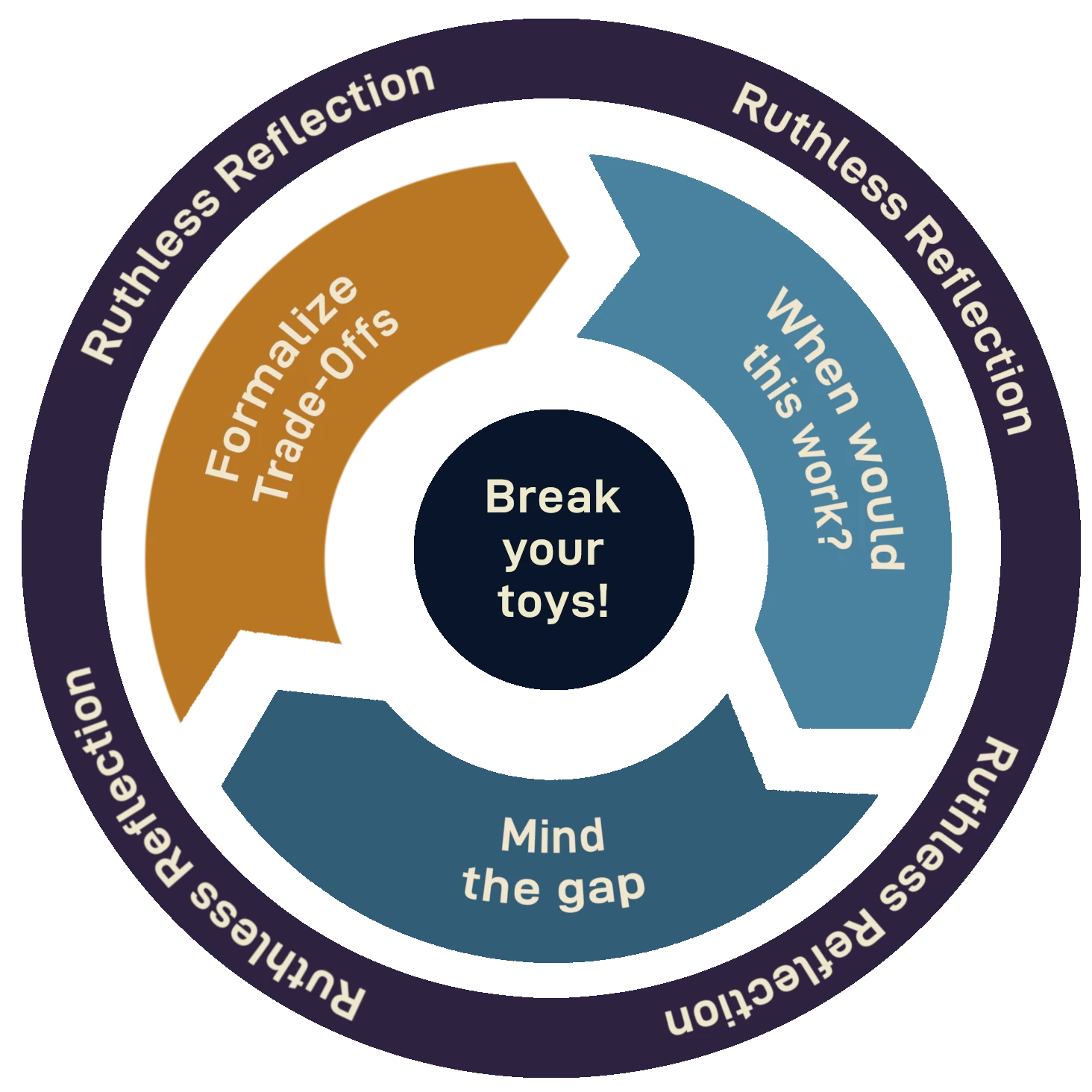
Tip 1: When Would This Work?
Asking yourself, ‘When would this work?’ is a powerful way to maintain both a realistic outlook and an openness to change.
Why Is This Important?
It’s easy to jump to conclusions about certain approaches, techniques, or technologies. If something doesn’t align with our instincts or prior experiences, we tend to dismiss it outright. Phrases like ‘This is a ridiculous idea; it’ll never work!’ are common. Take a look at your favorite technical discussion platform – be it LinkedIn, Reddit, StackExchange, or Hacker News – and you’ll find this behavior in action. People are quick to write off ideas that clash with their preferences or experiences. But what if the idea isn’t as flawed as it seems? What if it could work brilliantly in certain contexts? Could you be ignoring something that might save you in the future?
This is where the question, ‘When would this work?’ comes into play. Though simple, it’s incredibly effective. It encourages you to think beyond your immediate context and consider a broader perspective. Even if you never adopt a particular approach, cultivating the habit of questioning your initial reactions will help you grow into a more adaptable and well-rounded software architect.
How To Do It?
Seek out alternative perspectives:
Make a deliberate effort to expose yourself to ideas and viewpoints that differ from your own. Talk to colleagues in other departments, attend webinars outside your area of expertise, or read case studies from industries unrelated to yours. This can help you understand why others might support an approach you initially dismissed and highlight hidden strengths or weaknesses you hadn’t considered. The key is to actively listen and aim to understand rather than judge. You can always form an opinion later, once you’ve grasped their perspective.Conduct what-if thought experiments:
Take a few minutes to imagine how your idea would perform under different scenarios. What if your user base doubled? What if a critical dependency suddenly changed? What if your development team quit en masse, or your organization shifted its priorities overnight? Ask, ‘What if everything goes perfectly?’ and ‘What if everything goes horribly wrong?’ These exercises force you to evaluate edge cases, resource constraints, and even potential political challenges. They provide a more holistic understanding of an idea’s real-world feasibility. Just make sure to keep these experiments grounded in realism – there’s little point in wondering, ‘What if a meteorite hits the data center?’ unless you’re designing systems for deep-space habitats or intergalactic missions.Define use-case boundaries:
Clearly identify the contexts where a particular solution excels and where it fails. For example, is your chosen pattern ideal for transactional systems with predictable loads, or does it thrive in environments with traffic spikes? By defining these boundaries, you avoid over-committing to solutions that address only part of the problem. It also ensures you have alternative options ready for different scenarios. Remember, every approach has its strengths and limitations. Knowing when and where to apply a design, pattern, or technology is crucial to making informed decisions.
Tip 2: Formalise Trade-Offs
By systematically analyzing trade-offs[^1], you ensure your designs remain robust. You’ll also be better equipped to explain your rationale to others, making you a more effective and transparent architect.
Why Is This Important?
Every architectural decision involves a trade-off. It might be performance versus maintainability, cost versus scalability, or speed of delivery versus long-term flexibility. A common mistake, especially when you’re still learning, is rigidly adopting your favourite pattern or approach without considering the broader context. Developing the habit of regularly evaluating trade-offs will help you make more informed decisions. As an added benefit, it enhances your ability to communicate your reasoning clearly to your team and stakeholders.
In fact, systematically and transparently assessing different options is one of the most fundamental skills for any architect. By breaking down the pros and cons of each choice within the context of your project’s priorities, you create a repeatable framework for decision-making that can be applied to almost any situation. This practice also sharpens your ability to balance conflicting requirements, enabling you to deliver solutions that stand the test of time – or, at the very least, help you and others understand why a particular decision was the right one at the time.
How To Do It?
Identify the key success criteria:
Start by defining what ‘success’ looks like for the project or feature you’re designing. Is the top priority lightning-fast performance, ease of maintenance, or minimal cost? Collaborate with stakeholders to rank these criteria (for example, prioritise performance over maintainability). Understanding which factors truly drive success in your specific context ensures you know which aspects to emphasise – and which you can afford to compromise on – when evaluating alternatives.Seek input from those most impacted:
Consult the people who will feel the impact of your choices – developers, QA engineers, operational teams, and even non-technical stakeholders. Encourage them to voice concerns or identify potential pitfalls early in the process. For instance, if your design complicates the deployment pipeline, automation specialists should weigh in on its feasibility. By actively listening to each group, you’ll uncover critical factors you might otherwise miss. Assigning an excessive workload to an already overstretched team is unlikely to lead to success.Document your decisions:
After weighing your options and making a choice, document the reasoning behind it. A brief Architecture Decision Record or a wiki entry outlining the context, alternatives considered, trade-offs, and the final decision goes a long way. This documentation not only allows you to revisit your rationale in the future but also keeps your team aligned, minimizing confusion and preventing repeated debates. Clearly listing the trade-offs you made, the alternatives you explored, and the goals you prioritized will help you stay consistent and ensure others understand your decision-making process.
Tip 3: Mind the Gap
‘Minding the gap’ goes beyond software; it’s about creating alignment across all the people and processes that influence – or are influenced by – your architecture.
Why Is This Important?
Bridging gaps in software architecture isn’t just about connecting system components – it’s about uniting people, ideas, and objectives. Misalignment often arises when business goals and technical solutions don’t naturally converge, or when the front-end team’s interpretation of requirements is significantly different from that of the back-end team. These unaligned perspectives can lead to misunderstandings, miscommunications, and missed opportunities.
As a software architect, your job is to close these gaps. You need to ensure everyone is on the same page, that the right information reaches the right people, and that decisions are made with the full picture in mind. Sometimes, the gap isn’t just between teams – it’s between expectations and reality. Even if your design is technically flawless, if no one can build, maintain, or use it effectively, your efforts will ultimately go to waste.
How To Do It?
Understand the business and organisational context:
Before designing any architecture, take ample time to learn how your organization operates and what its priorities are. Who are the key stakeholders? Which teams or departments will your design affect? What do those teams already know, and where might their knowledge fall short? Gaining an understanding of power dynamics, budget constraints, and broader business objectives will help you avoid creating a technically brilliant solution that fails due to organizational friction or misalignment with real-world goals.Empathise and reality check:
Keep in mind that every affected party brings a unique perspective. For example:
- The UX lead may focus on front-end performance and page-load times.
- The database engineer may prioritize query optimization above all else.
- Business clients are likely concerned with meeting deadlines and seeing quick results.
- HR may worry about developer burnout or staff turnover.
Recognizing these different viewpoints, along with the desires and fears behind them, allows you to design a more cohesive architecture that accommodates varying needs. It also helps you anticipate potential conflicts and address them proactively.
Align on terminology:
Ensure everyone involved uses consistent definitions and shares a mutual understanding of the system and its goals. Business stakeholders often communicate in terms of metrics like ‘conversion rates’ or ‘revenue,’ while developers might think in terms of ‘APIs’, ‘frameworks’, or ‘deployment pipelines’. Translating business requirements into technical terms (and vice versa) prevents confusion and ensures everyone remains aligned.
Tip 4: Ruthless Reflection
Ruthless reflection keeps your learning process active and iterative, helping you avoid repeating mistakes and enabling you to refine your approach. It helps uncover patterns in your work and professional environment, allowing you to draw on past lessons to make more informed decisions in the future.
Why Is This Important?
One of the most difficult aspects of software architecture is operating in a complex, ever-changing environment. You need to stay adaptable to new situations, technologies, and organizational changes. What worked well yesterday might not be effective today, and a decision that was sound last year could easily be the worst choice now.
This constant state of flux can be both invigorating and frustrating. It challenges you to stay sharp but also makes it harder to learn from past experiences or to build on your past successes. The saying ‘there is no silver bullet’ is often repeated in software development, and it’s particularly relevant in software architecture. However, that doesn’t mean you can’t learn valuable lessons from previous projects.
While no two projects, teams, or clients are identical, there are always recurring themes and insights to be gained. Often, your current situation will contain subtle indicators – ’tells’ – that can help you predict what’s likely to succeed, what might fail, and what to watch out for. Gaining this kind of foresight comes from experience, but you can maximize the value of your experiences by reflecting on them regularly, deeply, and with ruthless honesty.
How To Do It?
- Touch base:
Make it a habit to connect with the teams and stakeholders who work with your architectural decisions daily. Attend stand-ups, ask for feedback in informal settings, or even shadow team members briefly to observe how the system performs under real-world conditions. This hands-on insight helps confirm or challenge your assumptions, reveal unanticipated issues, and show you exactly how people are interacting with – or struggling to use – the architecture you’ve designed. - Revisit past decisions:
Periodically review your past architectural choices and ask yourself what you could have done differently, given the information available at the time. Look for lapses in judgment, unchecked biases, or assumptions that weren’t validated. If possible, reach out to those who are currently using the systems you designed. Ask how things are going and whether any challenges have emerged. This feedback is invaluable for understanding the long-term impact of your decisions and refining your approach. - Keep a reflection log:
After each major design or implementation milestone, jot down what went well, what didn’t, and any unexpected lessons you learned. Over time, this log becomes a treasure trove of real-world insights, making it easier to identify recurring pitfalls and track how your decision-making evolves. Where possible, add these reflections to a shared knowledge base, such as a wiki, project README, or collaborative document. This not only helps you revisit your own insights but also allows others to learn from your experiences and provide feedback.
Tip 5: Break Your Toys!
By running multiple experiments on a small, ‘breakable’ project, you gain hands-on experience in how different architectural decisions play out – without jeopardizing business goals or team morale. When a live project later demands a specific pattern or approach, you’ll have practical insights to guide you.
Why Is This Important?
Software architecture is inherently complex, and the stakes for making poor decisions are high. Practicing your skills in a real-world setting is challenging because you can’t simply redesign your company’s core systems every few weeks. You can’t rewrite an entire application just because you read an intriguing new book. And you certainly can’t demand your teams overhaul their workflows just so you can test out a new idea or structure.
Well, you could – but you’d likely find yourself out of a job.
This is where having a ‘breakable toy’ becomes invaluable. It provides a safe, no-pressure environment to sharpen your architectural instincts. You can experiment freely with patterns, frameworks, and toolchains, observe how they behave, and learn from the outcomes – without causing production outages or derailing real projects. Essentially, you trade the high stakes and complexity of live systems for a controlled sandbox where you can fail fast, reflect on mistakes, and adjust your approach. Then, when an actual project requires a new solution, you’ll already have practical experience, enabling you to make confident, well-informed decisions.
How To Do It?
Small, simple, self-contained:
Select a project that’s straightforward enough to build quickly (such as a to-do list app, a recipe manager, or a small inventory system) but still offers enough complexity to test architectural decisions. The goal is experimentation, not perfection. By keeping the scope small, you can focus on the impact of your architectural choices rather than getting bogged down in the inherent complexity of the problem you’re exploring.Know when to move on:
One risk of a breakable toy is becoming too attached to it. You might end up spending more time on it than you intended or trying to perfect it. Remember, the goal isn’t to build a flawless product but to learn through the process. Once you’ve gained the knowledge or experience you set out to achieve, move on. Setting a clear learning objective from the start can help with this. For instance:- ‘I want to explore the implications of using an event-driven, microservices architecture.’
- ‘How far can I get by leveraging a generative AI to design and implement a system?’
- ‘I want to see how smoothly I can switch between front-end frameworks.’
Once you have gathered the insights you need, don’t be afraid to shelf the project, and move on to the next experiment. This is a great time to take a moment to reflect on the lessons learned, and to write down your findings for future reference.
Track your findings:
Maintain a log of your experiments, documenting your progress, discoveries, and reflections. This will help you stay on track during the process and provide a reference for later. Your notes will remind you of the key challenges you faced, the lessons you learned, and what you’d do differently next time. When it’s time to apply your knowledge to a real-world scenario, you’ll have a wealth of insights to draw upon. Occasionally, you can even share your breakable toy code or designs with others as a point of reference.
Conclusion
Becoming a better software architect is not about simply memorizing patterns or reading the right books. It’s about adopting a mindset that embraces trade-offs, prompts you to ask ‘When would this work?’, encourages collaboration, demands honest reflection, and supports safe experimentation. In our field, there is rarely a single ‘right’ answer – but there are always better questions.
Of course, if you’re still eager for a more traditional reading list, here are some gems I’ve found particularly enlightening. In no particular order:
- ‘The C4 Model for Software Architecture’ by Simon Brown :
A lightweight, visual approach to documenting your architecture. Its simplicity and people-focused design make it an excellent tool for communicating your ideas to a wide range of stakeholdersA lightweight, visual approach to documenting your architecture. Its simplicity and people-focused design make it an excellent tool for communicating your ideas to a wide range of stakeholders - ‘Design It! From Programmer to Software Architect’ by Michael Keeling : A practical guide that walks readers through real-world architectural challenges, complete with the author’s personal experiences and insights.
- ‘Driving Technical Change’ by Terrence Ryan : A resource focused on communication strategies and persuasion techniques to secure team buy-in—an essential skill for any architect looking to implement new ideas effectively.
- ‘Practical AMMERSE Series’ by Jonathan Crossland :
Hands-on articles that cover everything from architecture to team dynamics, with a strong emphasis on principle-based design and systemic thinking. - ‘Software Architecture Guide’ by Martin Fowler :
A curated collection of insights and patterns, providing a solid foundation for understanding modern architectural practices and principles, written by one of the most respected voices in the field. - ‘Agile Conversations’ by Douglas Squirrel and Jeffrey Fredrick :
A guide to improving communication skills, crucial for architects navigating the complex interplay between technical and interpersonal challenges. - ‘Cloud Design Patterns’ from the Microsoft Azure Architecture Center :
Well-structured, practical guidance on building resilient, cloud-native solutions. It covers topics like scalability, security, and distributed systems, making it valuable even beyond cloud environments.
At the end of the day, the best way to grow as a software architect is by designing architectures. Whether you’re exploring architecture guides or experimenting with your own ‘breakable toy’, the key is to keep evolving. Each decision you make, every reflection you engage in, and every experiment you undertake sharpens your instincts and deepens your expertise.
Good luck—and happy designing!
[^1] For a more in depth look at trade-offs, take a look at the Software Architecture in a nutshell description on our knowledge base.